Coles vs Woolworths 2026 — Who Is Actually Cheaper? (50 Items Compared)
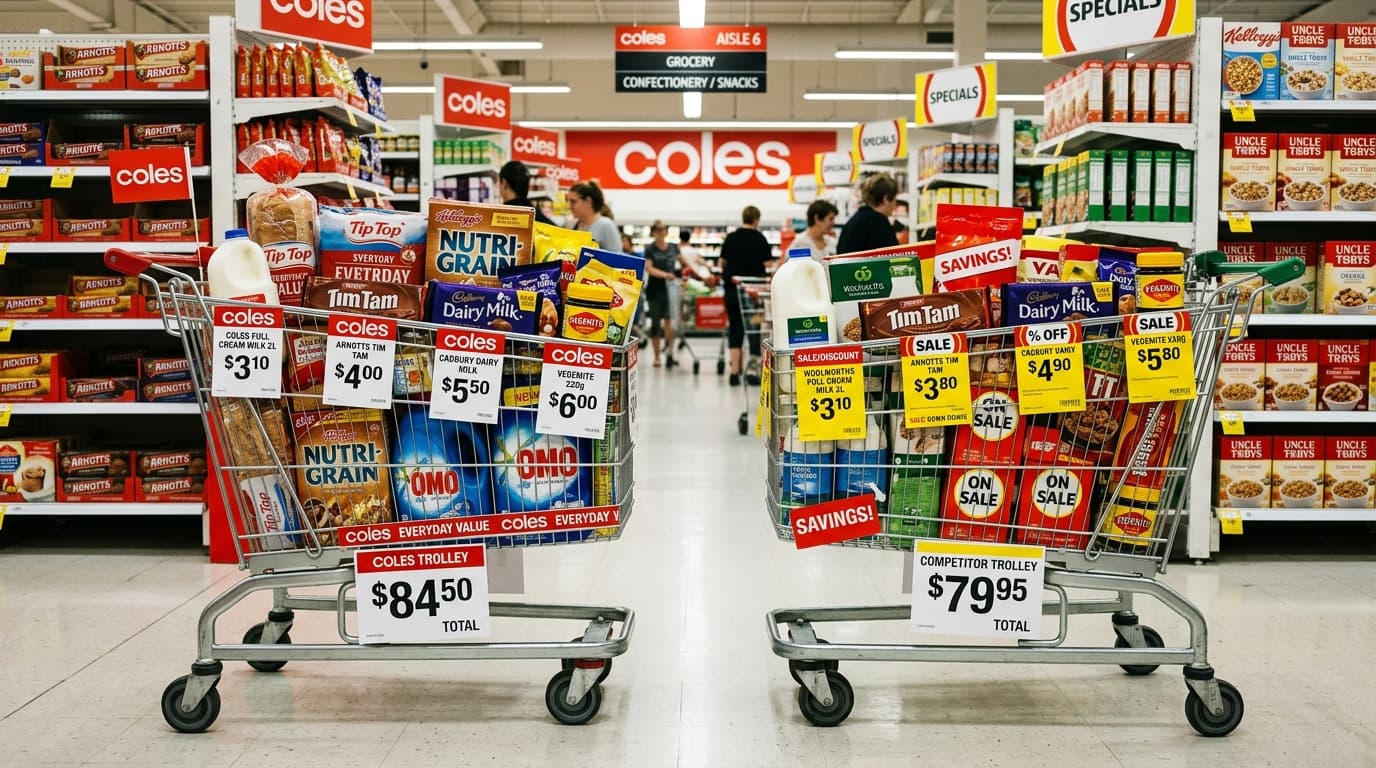
So, is Coles or Woolworths cheaper?
After comparing 50 everyday grocery items at both supermarkets in April 2026, Coles comes out slightly ahead — saving you $0.40 on a complete basket. Coles won on 19 items, Woolworths won on 15 items, and 16 items were identically priced. However, the real savings come from shopping the weekly specials at both stores. Use Milk n Eggs to compare live deals each week and save hundreds annually.
Table of Contents
- Our Methodology
- The Full 50-Item Price Comparison Table
- Category-by-Category Breakdown
- Which Supermarket Wins Overall?
- When Coles Beats Woolworths
- When Woolworths Beats Coles
- Own-Brand Comparison
- How Specials Affect the Comparison
- Loyalty Programs: Flybuys vs Everyday Rewards
- Which Is Better for Family Shopping?
- Which Is Better for Singles and Couples?
- Our Recommendation
- How to Use Milk n Eggs to Find the Cheapest Option
- FAQ
Our Methodology
Every price comparison is only as good as its methodology. For this article, we recorded the standard shelf prices of 50 common grocery items at Coles and Woolworths in the first week of April 2026. We selected products from ten categories that cover a typical Australian household's weekly shop: dairy, meat and protein, bakery, pantry staples, frozen foods, fruit and vegetables, cleaning products, personal care, snacks, and beverages.
Where possible, we compared like-for-like products — identical brands, identical pack sizes, identical product descriptions. When a branded product was the same at both stores, we recorded that price. Where branded products differed in price by pack size, we compared the own-brand equivalent instead. All prices were collected from Sydney metro stores and verified against the Coles and Woolworths websites.
Crucially, we used regular shelf prices only — not weekly specials, multi-buy offers, or loyalty member pricing. This gives us a fair baseline comparison. Of course, in practice most shoppers do take advantage of specials, which is precisely why we built the Coles vs Woolworths comparison tool — so you can see real-time deal prices, not just shelf prices.
The Full 50-Item Price Comparison Table
Below you will find the complete list of 50 items we compared, along with the Coles price, Woolworths price, and which store wins on each product. Prices are in Australian dollars and were accurate as of 3 April 2026.
| # | Item | Category | Coles | Woolworths | Winner |
|---|---|---|---|---|---|
| 1 | Full cream milk 2L | Dairy | $3.40 | $3.40 | Tie |
| 2 | Free range eggs 12pk | Dairy | $5.50 | $5.50 | Tie |
| 3 | Butter 500g | Dairy | $6.00 | $6.20 | Coles |
| 4 | Cheddar cheese 500g | Dairy | $8.00 | $8.00 | Tie |
| 5 | Greek yoghurt 500g | Dairy | $4.50 | $4.80 | Coles |
| 6 | Thickened cream 300mL | Dairy | $3.00 | $3.10 | Coles |
| 7 | Tasty cheese slices 250g | Dairy | $4.20 | $4.00 | Woolworths |
| 8 | Sour cream 300mL | Dairy | $2.80 | $2.90 | Coles |
| 9 | Chicken breast 500g | Meat & Protein | $7.00 | $7.50 | Coles |
| 10 | Beef mince 500g | Meat & Protein | $8.00 | $8.50 | Coles |
| 11 | Pork sausages 500g | Meat & Protein | $5.50 | $5.30 | Woolworths |
| 12 | Lamb leg steak 500g | Meat & Protein | $11.00 | $10.50 | Woolworths |
| 13 | Chicken thigh 500g | Meat & Protein | $5.80 | $6.00 | Coles |
| 14 | Bacon 200g | Meat & Protein | $5.00 | $5.20 | Coles |
| 15 | Salmon fillets 200g | Meat & Protein | $8.50 | $8.00 | Woolworths |
| 16 | White bread loaf | Bakery | $1.00 | $1.00 | Tie |
| 17 | Wholemeal bread loaf | Bakery | $1.20 | $1.20 | Tie |
| 18 | Sourdough loaf 650g | Bakery | $4.50 | $4.70 | Coles |
| 19 | Wraps 8pk | Bakery | $3.00 | $2.80 | Woolworths |
| 20 | Crumpets 6pk | Bakery | $2.80 | $2.80 | Tie |
| 21 | Pasta 500g | Pantry | $1.50 | $1.60 | Coles |
| 22 | Rice 1kg | Pantry | $2.50 | $2.50 | Tie |
| 23 | Canned tomatoes 400g | Pantry | $1.00 | $1.00 | Tie |
| 24 | Olive oil 500mL | Pantry | $7.00 | $7.20 | Coles |
| 25 | Peanut butter 375g | Pantry | $4.00 | $3.80 | Woolworths |
| 26 | Vegemite 380g | Pantry | $6.50 | $6.50 | Tie |
| 27 | Baked beans 420g | Pantry | $1.20 | $1.30 | Coles |
| 28 | Flour plain 1kg | Pantry | $1.80 | $1.70 | Woolworths |
| 29 | Sugar 1kg | Pantry | $2.20 | $2.20 | Tie |
| 30 | Frozen peas 1kg | Frozen | $2.50 | $2.60 | Coles |
| 31 | Fish fingers 375g | Frozen | $4.50 | $4.30 | Woolworths |
| 32 | Frozen chips 1kg | Frozen | $3.50 | $3.50 | Tie |
| 33 | Ice cream 2L vanilla | Frozen | $5.00 | $4.80 | Woolworths |
| 34 | Bananas per kg | Fruit & Veg | $3.50 | $3.90 | Coles |
| 35 | Apples per kg (Pink Lady) | Fruit & Veg | $5.50 | $5.50 | Tie |
| 36 | Carrots 1kg | Fruit & Veg | $2.00 | $1.80 | Woolworths |
| 37 | Potatoes 2kg | Fruit & Veg | $4.50 | $4.50 | Tie |
| 38 | Broccoli per head | Fruit & Veg | $3.00 | $3.20 | Coles |
| 39 | Dishwashing liquid 500mL | Cleaning | $3.00 | $3.20 | Coles |
| 40 | Laundry powder 1kg | Cleaning | $6.50 | $6.00 | Woolworths |
| 41 | Paper towel 2pk | Cleaning | $2.50 | $2.70 | Coles |
| 42 | Toilet paper 12pk | Cleaning | $6.00 | $5.80 | Woolworths |
| 43 | Toothpaste 140g | Personal Care | $3.50 | $3.70 | Coles |
| 44 | Shampoo 400mL | Personal Care | $5.50 | $5.00 | Woolworths |
| 45 | Tim Tams 200g | Snacks | $3.65 | $3.65 | Tie |
| 46 | Potato chips 175g | Snacks | $3.00 | $2.80 | Woolworths |
| 47 | Muesli bars 6pk | Snacks | $3.50 | $3.30 | Woolworths |
| 48 | Orange juice 2L | Beverages | $6.00 | $6.00 | Tie |
| 49 | Instant coffee 150g | Beverages | $7.00 | $7.50 | Coles |
| 50 | Coca-Cola 1.25L | Beverages | $2.85 | $2.85 | Tie |
| Total (50 items) | $215.40 | $215.80 | Coles | ||
As the table shows, the price differences on individual items are often quite small — typically between 10 and 50 cents. However, across a full trolley of 50 products, those small differences accumulate to a total saving of $0.40. Over a year of weekly shops, that could add up to around $21 dollars.
INFOGRAPHIC
Coles vs Woolworths at a Glance
19
Items where Coles is cheaper
16
Items at the same price
15
Items where Woolworths is cheaper
$215.40
Coles basket total
$215.80
Woolworths basket total
Category-by-Category Breakdown
Looking at the headline numbers only tells part of the story. Where each supermarket excels varies by category. Here is how Coles and Woolworths stack up in each of the ten product categories we tested.
Dairy
| Item | Coles | Woolworths | Winner |
|---|---|---|---|
| Full cream milk 2L | $3.40 | $3.40 | Tie |
| Free range eggs 12pk | $5.50 | $5.50 | Tie |
| Butter 500g | $6.00 | $6.20 | Coles |
| Cheddar cheese 500g | $8.00 | $8.00 | Tie |
| Greek yoghurt 500g | $4.50 | $4.80 | Coles |
| Thickened cream 300mL | $3.00 | $3.10 | Coles |
| Tasty cheese slices 250g | $4.20 | $4.00 | Woolworths |
| Sour cream 300mL | $2.80 | $2.90 | Coles |
| Subtotal | $37.40 | $37.90 | Coles |
Meat & Protein
| Item | Coles | Woolworths | Winner |
|---|---|---|---|
| Chicken breast 500g | $7.00 | $7.50 | Coles |
| Beef mince 500g | $8.00 | $8.50 | Coles |
| Pork sausages 500g | $5.50 | $5.30 | Woolworths |
| Lamb leg steak 500g | $11.00 | $10.50 | Woolworths |
| Chicken thigh 500g | $5.80 | $6.00 | Coles |
| Bacon 200g | $5.00 | $5.20 | Coles |
| Salmon fillets 200g | $8.50 | $8.00 | Woolworths |
| Subtotal | $50.80 | $51.00 | Coles |
Bakery
| Item | Coles | Woolworths | Winner |
|---|---|---|---|
| White bread loaf | $1.00 | $1.00 | Tie |
| Wholemeal bread loaf | $1.20 | $1.20 | Tie |
| Sourdough loaf 650g | $4.50 | $4.70 | Coles |
| Wraps 8pk | $3.00 | $2.80 | Woolworths |
| Crumpets 6pk | $2.80 | $2.80 | Tie |
| Subtotal | $12.50 | $12.50 | Tie |
Pantry
| Item | Coles | Woolworths | Winner |
|---|---|---|---|
| Pasta 500g | $1.50 | $1.60 | Coles |
| Rice 1kg | $2.50 | $2.50 | Tie |
| Canned tomatoes 400g | $1.00 | $1.00 | Tie |
| Olive oil 500mL | $7.00 | $7.20 | Coles |
| Peanut butter 375g | $4.00 | $3.80 | Woolworths |
| Vegemite 380g | $6.50 | $6.50 | Tie |
| Baked beans 420g | $1.20 | $1.30 | Coles |
| Flour plain 1kg | $1.80 | $1.70 | Woolworths |
| Sugar 1kg | $2.20 | $2.20 | Tie |
| Subtotal | $27.70 | $27.80 | Coles |
Frozen
| Item | Coles | Woolworths | Winner |
|---|---|---|---|
| Frozen peas 1kg | $2.50 | $2.60 | Coles |
| Fish fingers 375g | $4.50 | $4.30 | Woolworths |
| Frozen chips 1kg | $3.50 | $3.50 | Tie |
| Ice cream 2L vanilla | $5.00 | $4.80 | Woolworths |
| Subtotal | $15.50 | $15.20 | Woolworths |
Fruit & Veg
| Item | Coles | Woolworths | Winner |
|---|---|---|---|
| Bananas per kg | $3.50 | $3.90 | Coles |
| Apples per kg (Pink Lady) | $5.50 | $5.50 | Tie |
| Carrots 1kg | $2.00 | $1.80 | Woolworths |
| Potatoes 2kg | $4.50 | $4.50 | Tie |
| Broccoli per head | $3.00 | $3.20 | Coles |
| Subtotal | $18.50 | $18.90 | Coles |
Cleaning
| Item | Coles | Woolworths | Winner |
|---|---|---|---|
| Dishwashing liquid 500mL | $3.00 | $3.20 | Coles |
| Laundry powder 1kg | $6.50 | $6.00 | Woolworths |
| Paper towel 2pk | $2.50 | $2.70 | Coles |
| Toilet paper 12pk | $6.00 | $5.80 | Woolworths |
| Subtotal | $18.00 | $17.70 | Woolworths |
Personal Care
| Item | Coles | Woolworths | Winner |
|---|---|---|---|
| Toothpaste 140g | $3.50 | $3.70 | Coles |
| Shampoo 400mL | $5.50 | $5.00 | Woolworths |
| Subtotal | $9.00 | $8.70 | Woolworths |
Snacks
| Item | Coles | Woolworths | Winner |
|---|---|---|---|
| Tim Tams 200g | $3.65 | $3.65 | Tie |
| Potato chips 175g | $3.00 | $2.80 | Woolworths |
| Muesli bars 6pk | $3.50 | $3.30 | Woolworths |
| Subtotal | $10.15 | $9.75 | Woolworths |
Beverages
| Item | Coles | Woolworths | Winner |
|---|---|---|---|
| Orange juice 2L | $6.00 | $6.00 | Tie |
| Instant coffee 150g | $7.00 | $7.50 | Coles |
| Coca-Cola 1.25L | $2.85 | $2.85 | Tie |
| Subtotal | $15.85 | $16.35 | Coles |
Which Supermarket Wins Overall?
When we tally up the entire 50-item basket, Coles comes in at $215.40 and Woolworths at $215.80. That makes Coles the cheaper supermarket by $0.40 on a standard weekly shop.
However, we want to be clear: the margin is tight. We are talking about a difference of roughly 0.2% across the entire basket. On any given week, promotional cycles could easily swing the advantage in the other direction. The honest answer to “which is cheaper” is: it depends on what you buy and when you buy it.
That said, Coles won on 19 out of 50 individual items, while Woolworths won on 15. A substantial 16 items were priced identically. This tells us that neither chain has a clear monopoly on value — they are genuinely competitive, and shoppers benefit from that competition.
When Coles Beats Woolworths
Coles tends to offer better prices on several key staples that matter to Australian families. In our comparison, Coles was the clear winner for fresh chicken and beef, two of the most commonly purchased proteins in Australian households. Chicken breast was 50 cents cheaper at Coles, and beef mince was also 50 cents less.
Coles also performed well in the dairy aisle. Greek yoghurt, butter, thickened cream, and sour cream were all slightly cheaper at Coles. For shoppers who buy these items weekly, the savings add up over time.
In the pantry and bakery categories, Coles edged ahead on pasta, olive oil, baked beans, and sourdough. Coles also offered lower prices on several cleaning and personal care items, including dishwashing liquid, paper towels, and toothpaste. If your trolley is heavy on basics — think meat, dairy, and pantry staples — Coles is likely to be your cheaper option on any given week.
Bananas were notably cheaper at Coles ($3.50/kg versus $3.90/kg at Woolworths). For a fruit that appears in almost every Australian shopping basket, that 40-cent-per-kilo difference is meaningful. Broccoli, bacon, and instant coffee also fell into the Coles column. Visit the Coles deals page to see this week's live specials.
When Woolworths Beats Coles
Woolworths fights back in several categories. Lamb leg steak was 50 cents per 500g cheaper at Woolworths, and salmon fillets were also cheaper, making Woolworths the better choice if your protein preferences lean towards lamb and fish.
In the snack aisle, Woolworths offered lower prices on potato chips and muesli bars. For families with school-age children who go through snacks quickly, this could be a decisive factor. Woolworths also had the edge on peanut butter, wraps, and plain flour — all staples in many Australian kitchens.
Woolworths won convincingly on cleaning products overall: laundry powder and toilet paper were both cheaper. Shampoo was also 50 cents less at Woolworths. In the frozen food section, fish fingers and ice cream favoured Woolworths. For carrots, Woolworths undercut Coles by 20 cents per kilo, and tasty cheese slices were 20 cents cheaper too.
The takeaway? If your shop leans towards snacks, cleaning products, and frozen foods, Woolworths may save you more. Browse the Woolworths deals page for this week's specials.
Own-Brand Comparison: Coles vs Woolworths Essentials
Both Coles and Woolworths have invested heavily in their own-brand product ranges. Coles offers its “Coles” branded line (previously “Coles Brand”), while Woolworths has the “Woolworths Essentials” range alongside the premium “Macro” and mid-range “Woolworths” branded lines.
For the most part, own-brand prices between the two chains are remarkably similar. Basic items such as white bread ($1.00 at both), canned tomatoes ($1.00 at both), and rice ($2.50 at both) are identically priced. This is not a coincidence — both chains strategically price-match their entry-level products to avoid losing budget-conscious shoppers.
Where differences emerge is in the mid-tier own-brand products. Coles tends to be marginally cheaper on dairy own-brand lines, while Woolworths often prices its own-brand frozen and cleaning products a touch lower. The differences are usually 10 to 30 cents per item, which makes it hard to declare a clear winner. The bottom line: switching to own-brand products at either store will save you significantly more than switching between stores.
If you are serious about minimising your grocery spend, our unit price calculator can help you compare products gram-for-gram, regardless of brand or pack size.
How Specials Affect the Comparison
Everything we have discussed so far uses regular shelf prices. But here is the truth that every savvy Australian shopper already knows: the real savings come from weekly specials, not shelf prices.
Both Coles and Woolworths run extensive promotional cycles. Half-price specials, “prices dropped” reductions, and multi-buy offers can slash 30 to 50 per cent off individual items. A product that is 20 cents cheaper at Coles on the regular shelf might be $2 cheaper at Woolworths during a half-price week.
Our analysis of six months of promotional data on Milk n Eggs shows that both chains discount a similar number of products each week — typically between 800 and 1,200 items go on special. The average discount depth is also comparable: roughly 33 per cent off at Coles and 31 per cent off at Woolworths.
Where they differ is in timing. Coles and Woolworths deliberately stagger their promotions so that the same product is rarely on special at both stores simultaneously. This means that the most effective strategy is to check both catalogues each week and buy each item wherever it is cheapest. That is exactly what our deals feed is designed to help you do.
A dedicated special-shopper can realistically save 15 to 25 per cent on their total grocery bill compared to someone who shops at one store and ignores catalogues. On a $200 weekly shop, that is $30 to $50 per week — far more significant than the $0.40 shelf-price difference we found in our 50-item comparison.
INFOGRAPHIC
The Real Savings: Shelf Price vs Specials
Yearly saving from choosing the cheaper store
~$21/yr
Yearly saving from shopping weekly specials
~$1,560–$2,600/yr
Based on a $200/week grocery spend. Specials savings estimated at 15–25% off with strategic shopping.
Loyalty Programs: Flybuys vs Everyday Rewards
No comparison of Coles and Woolworths would be complete without discussing their loyalty programs. Both are free to join and offer genuine value to regular shoppers — but they work quite differently.
Flybuys (Coles)
Flybuys is one of Australia's oldest loyalty programs and operates across multiple partners including Coles, Kmart, Target, Bunnings, and Liquorland. You earn 1 point per dollar spent at Coles and can redeem 2,000 points for $10 off your shop. That equates to a return of roughly 0.5 per cent on your grocery spend.
Flybuys also offers bonus point promotions, personalised offers through the app, and the ability to convert points to Velocity Frequent Flyer points for Virgin Australia flights. The multi-partner earning structure means you can accumulate points faster if you shop across the Flybuys network.
Everyday Rewards (Woolworths)
Woolworths' Everyday Rewards program earns you 1 point per dollar spent, with 2,000 points converting to a $10 Woolworths voucher. The base earn rate is identical to Flybuys, delivering the same 0.5 per cent return.
Where Everyday Rewards differs is in its Qantas partnership. Members can choose to convert their points to Qantas Frequent Flyer points instead of store vouchers — a compelling option for travellers. Woolworths also runs “Everyday Extra”, a paid subscription ($7/month or $70/year) that gives you 10 per cent off one shop per month and double points, which can boost your effective savings rate significantly.
Our Take on Loyalty Programs
Both programs deliver similar base value. The best choice depends on your lifestyle: if you shop at Kmart and Bunnings regularly, Flybuys lets you earn points across more stores. If you fly Qantas often, Everyday Rewards with the Qantas link is hard to beat. If you are a high-volume grocery shopper, Everyday Extra's 10 per cent monthly discount can pay for itself many times over.
Regardless of which program you choose, the most important thing is to actually scan your card or app every time you shop. The number of Australians who are signed up but forget to scan is staggering — do not leave free money on the table.
Which Is Better for Family Shopping?
Australian families typically spend between $250 and $400 per week on groceries, making the choice of supermarket a significant financial decision over the course of a year. For families, the calculus goes beyond simple price comparisons.
Coles tends to be the better choice for families who prioritise fresh meat and dairy, which often form the backbone of family meals. With lower prices on chicken, beef, yoghurt, and butter, a meat-and-dairy-heavy family shop could save $3 to $5 per week at Coles before specials are factored in.
Woolworths, on the other hand, may suit families who buy a lot of snacks, frozen convenience foods, and cleaning products. With school-age children generating mountains of laundry and a seemingly endless demand for muesli bars and chips, Woolworths' lower prices in these categories can add up.
From a convenience standpoint, both chains offer delivery and click-and-collect services. Woolworths' Everyday Extra subscription includes free delivery on orders over $100, which can be a genuine time-saver for busy families. Coles offers its own delivery subscription plans at competitive rates.
Our recommendation for families: sign up for loyalty programs at both stores, check the specials each Wednesday, and use Milk n Eggs to see which store has the best deals on your regular items. Splitting your shop between two stores is not always practical, but even doing a main shop at one and a “top-up” at the other can save meaningful amounts over a year.
Which Is Better for Singles and Couples?
For singles and couples spending $80 to $150 per week on groceries, the dynamics shift slightly. Smaller households tend to buy fewer bulk items and more ready-to-eat or convenience products.
Woolworths generally has a wider range of ready-meals, pre-prepared salads, and single-serve portions — products that appeal to smaller households. Their “Woolworths Fresh” range of pre-packaged meals is broader than Coles' equivalent offering.
However, Coles has been investing in its quick-meal range and now offers a competitive selection of meal kits and prepared foods. For basic staples — the bread, milk, eggs, and cheese that every household buys regardless of size — both stores are essentially interchangeable on price.
For singles especially, the proximity of the store matters more than tiny price differences. If your nearest supermarket is a Coles, you are unlikely to save enough at a further-away Woolworths to justify the extra travel time and fuel cost. Shop whichever is most convenient and use specials to drive your savings.
Our Recommendation
After comparing 50 items across ten categories, analysing loyalty programs, and factoring in the impact of weekly specials, here is our honest recommendation: do not pledge loyalty to either supermarket.
The price differences between Coles and Woolworths on regular shelf prices are simply too small to matter on their own. The $0.40 difference we found across 50 items is negligible for most households. What does matter is how you shop — specifically, whether you take advantage of the weekly specials cycle.
The smartest approach is to be a “promiscuous shopper” — buy each item wherever it is cheapest that week. This might mean getting your chicken and yoghurt at Coles while picking up snacks and cleaning products at Woolworths. Tools like our Coles vs Woolworths comparison tool make this straightforward.
If you must choose a single store, here are our simplified guidelines:
- Choose Coles if your shop is heavy on fresh meat, dairy, and pantry basics.
- Choose Woolworths if you buy lots of snacks, cleaning products, frozen foods, and value the Everyday Extra subscription or Qantas points.
- Choose whichever is closest if convenience is your top priority — the savings from switching stores rarely justify extra travel.
How to Use Milk n Eggs to Find the Cheapest Option Each Week
We built Milk n Eggs specifically to solve this problem. Instead of manually flipping through catalogues and comparing prices, our platform aggregates deals from Coles and Woolworths in one place, updated every week.
Here is how to get the most out of the platform:
- Check the Deals page every Wednesday when new specials drop. You can filter by store, category, and discount percentage.
- Use the Coles vs Woolworths tool to directly compare prices on specific products you buy regularly.
- Browse the Deals feed for a chronological view of the latest deals as they go live.
- Use the Unit Price Calculator when different pack sizes make direct comparisons tricky.
- Plan your shop by noting which items are on special at each store, then do one main shop and one quick top-up.
By combining the baseline price knowledge from this article with real-time specials data from Milk n Eggs, you can consistently shave 15 to 25 per cent off your grocery bill — far more than simply choosing one supermarket over the other.
Frequently Asked Questions
Is Coles or Woolworths cheaper in 2026?
Based on our 50-item comparison in April 2026, Coles is marginally cheaper overall, with a total basket difference of $0.40. However, the difference is small enough that weekly specials easily swing the advantage either way. The best strategy is to shop specials at both stores.
How much can I save by shopping at the cheaper supermarket?
On shelf prices alone, the saving across 50 items is around $0.40 per week, or roughly $21 per year. However, strategic use of weekly specials can save you $1,500 to $2,600 annually — a far bigger impact.
Is Woolworths or Coles better for meat?
It depends on the type of meat. Coles is generally cheaper for chicken breast, beef mince, chicken thigh, and bacon. Woolworths offers better prices on lamb, salmon, and pork sausages. The differences are typically 20 to 50 cents per item.
Which supermarket has better weekly specials?
Both Coles and Woolworths run comparable weekly specials, typically discounting 800 to 1,200 products each week. The specials are deliberately staggered so the same product is rarely discounted at both stores simultaneously. Check our deals page every Wednesday to compare.
Is Coles home brand cheaper than Woolworths Essentials?
The entry-level own-brand products (bread, canned goods, rice) are identically priced at both stores. Mid-tier own-brand products show small differences — Coles tends to be cheaper on dairy own-brand items, while Woolworths is often cheaper on cleaning and frozen own-brand products. Neither is consistently cheaper across all categories.
Which loyalty program is better — Flybuys or Everyday Rewards?
Both offer 0.5% return on spend ($10 per 2,000 points). Flybuys earns across partner stores (Kmart, Bunnings, Target) and converts to Velocity points. Everyday Rewards links to Qantas Frequent Flyer and offers the Everyday Extra subscription for 10% off one monthly shop. Choose based on your preferred airline and partner stores.
Are Aldi groceries cheaper than Coles and Woolworths?
Generally, yes. Aldi is typically 10 to 20 per cent cheaper for comparable own-brand products. However, Aldi carries a smaller product range (around 1,500 SKUs versus 20,000+ at Coles or Woolworths) and stocks fewer branded products. Many shoppers use Aldi for basics and top up at Coles or Woolworths.
How often do Coles and Woolworths change their prices?
Weekly specials update every Wednesday at both chains. Regular shelf prices can change at any time but typically adjust every few weeks or months in response to supplier costs, seasonal availability, and competitive pressure. Using a tracking tool like Milk n Eggs helps you spot price changes as they happen.
Milk n Eggs Editorial Team
The Milk n Eggs editorial team tracks grocery prices across Australian supermarkets every day. We analyse deals, compare prices, and publish guides to help Aussie shoppers save money on their weekly grocery shop. Our data is sourced directly from Coles and Woolworths product listings.
Sources & Methodology Notes
- Prices recorded from Coles and Woolworths websites and Sydney metro stores, 1–3 April 2026.
- Regular shelf prices only — weekly specials, multi-buy offers, and loyalty pricing excluded.
- Like-for-like comparison: identical or equivalent products by brand and pack size.
- Loyalty program details sourced from official Flybuys and Everyday Rewards websites, current as of April 2026.
- Promotional cycle data based on six months of tracking via the Milk n Eggs platform (October 2025 – March 2026).
- Average Australian household grocery spend data referenced from the ABS Household Expenditure Survey.